PARALLAX
... is a specialized library designed to solve partial differential equations (PDEs) for fusion research using the Flux Coordinate Independent (FCI) approach. It provides a range of functionalities, including:
Core Features:
- Magnetic Field Handling: Supports various magnetic field configurations, including both tokamak and stellarator equilibria, which can be prescribed either numerically or analytically.
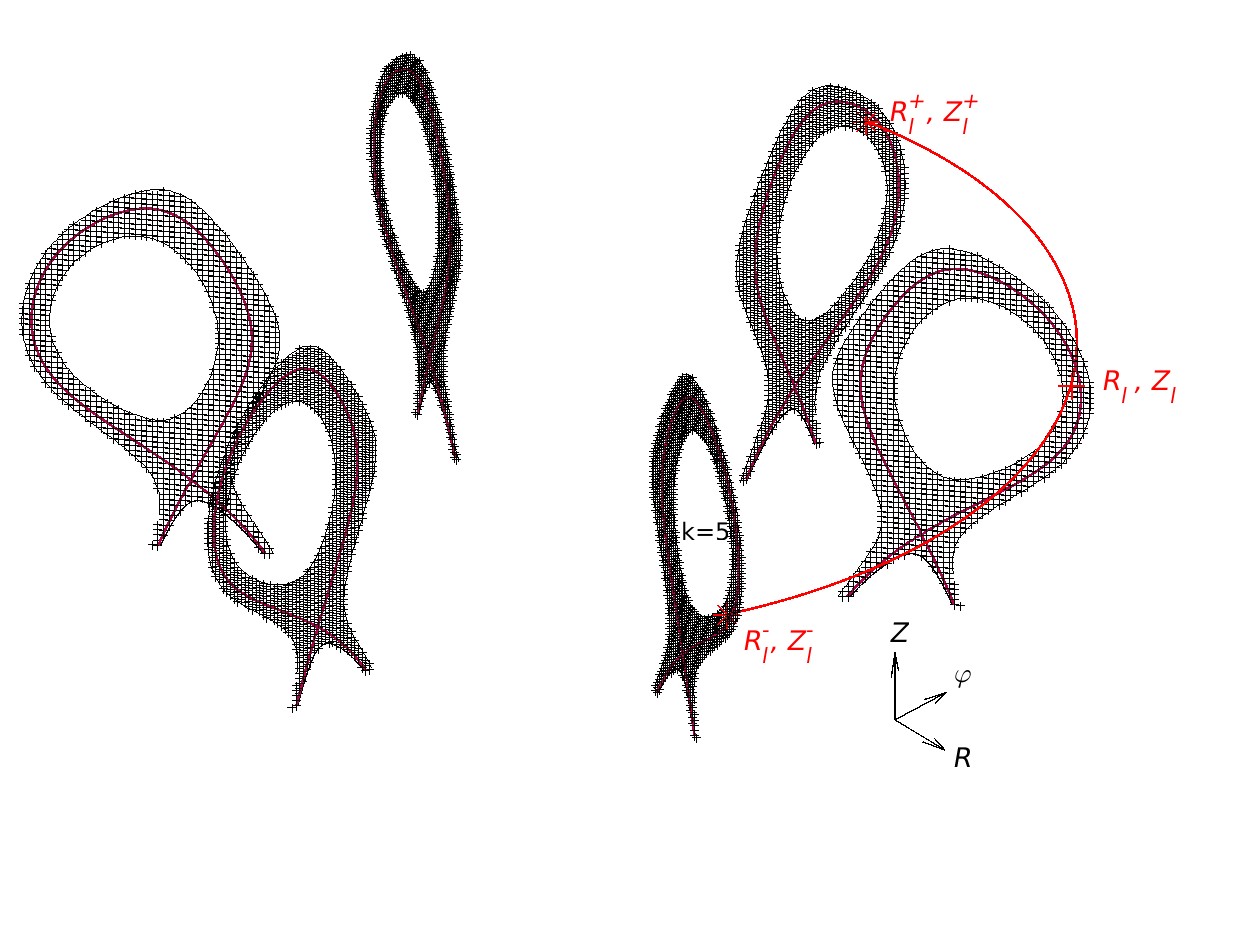
- Mesh Generation: Generates locally Cartesian, logically unstructured meshes representing 2D poloidal planes in the (R, (\phi), Z) coordinate system.
- FCI Discrete Operators: Utilizes field line tracing and interpolation within the (R, Z) meshes to create FCI-related discrete operators, such as the parallel gradient matrix.
- Elliptic Equation Solver: Offers a field solver capable of inverting elliptic equations on 2D planes independently. This solver is optimized by an in-house developed geometric multigrid preconditioner, making it highly efficient.
Additional Functionalities:
- Matrix-Free 3D Iterative Solver: A 3D solver that operates in a matrix-free manner, allowing users to provide the matrix-vector product and preconditioner as subroutines.
- Polar Mesh: Provides a polar mesh based on the geometric poloidal angle, with built-in routines for mapping between the Cartesian and polar meshes. It also includes flux surface operators for enhanced calculations.
- 3D Visualization Support: Allows for 3D visualization by exporting the mesh in a locally field-aligned description, based on the VTK format, for better representation of the magnetic field and geometry.
PARALLAX serves as the foundational library for the edge fluid turbulence code GRILLIX and the edge gyro-kinetic code GENE-X. Both codes are designed to self-consistently model plasma turbulence across the separatrix.
PARALLAX is developed at the Max Planck Institute for Plasma Physics (see Contact and Contributors).
PARALLAX is licensed under version 3 of the GNU Lesser General Public License (LGPL-3.0). See LICENSE file.