Flux-Coordinate independent approach
The Flux-Coordinate Independent (FCI) approach aims to discretize the plasma domain using a cylindrical grid , where each toroidal location is associated with a locally Cartesian mesh (logically unstructured with index ). The grid typically has a sparse resolution along the toroidal direction and a denser resolution within the poloidal planes. To discretize parallel operators, field line tracing is performed between adjacent planes, and interpolation within the poloidal planes is used to obtain values on mapped points. Using this information, parallel operators are constructed, for example, by applying finite differences along the magnetic field lines.
There are various options for discretization choices, such as the type of interpolation or the use of staggered grids for mimetic discretizations (also known as the support operator method), which have been discussed extensively in the literature (see TODO). PARALLAX provides all the necessary tools to customize the discretization process to meet your specific needs. To help you get started, we first present an example demonstrating how to compute the parallel gradient using the central finite difference method. We then explore the numerics and algorithms behind the field line tracing and interpolation procedures. Lastly, we discuss advanced discretization schemes, including the mimetic finite difference formulation of the FCI, commonly referred to as the support operator method.
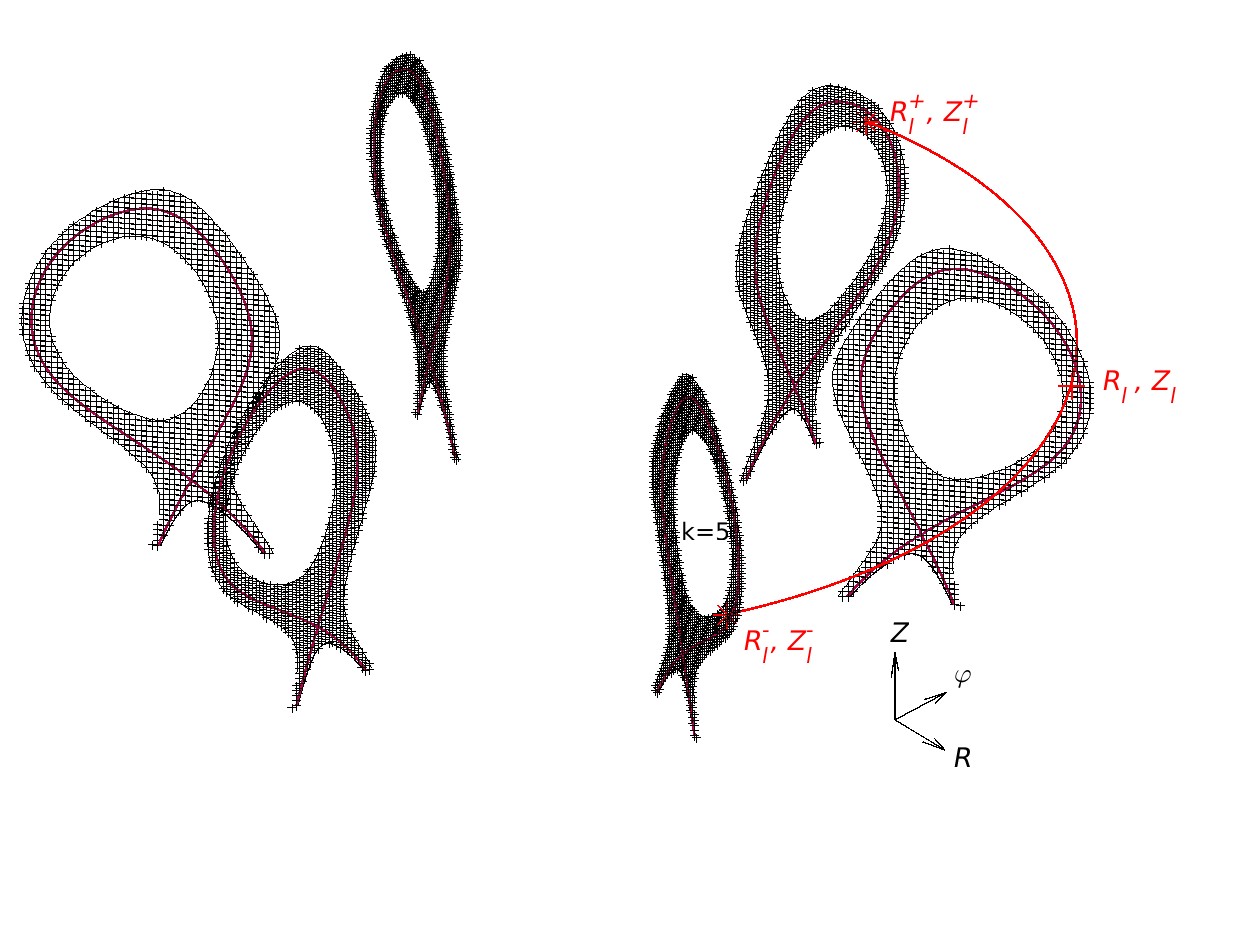
Overview of the Flux-Coordinate Independent (FCI) approach. Parallel operators are discretized by tracing field lines to adjacent planes and performing interpolation to obtain values at mapped points.